[Weekly Retro] Climbing the hill of ambiguity
#269 - Jan.2026
Hi there!
This week I stumbled upon a concept again and remembered how much I like it!
I've never been a fan of tracking tasks using percentages (really?!). Even when using progress status (e.g., "ongoing") or color codes ("green," "red," "yellow"), it's very hard to really understand where things are and, most importantly, when help or attention is needed.
Have you heard about hill charts?
The idea is simple. Generally, tasks have two stages: figuring out what to do and getting it done. In addition to the status, you track tasks on which part of the hill they are. Figuring out what to do commonly takes more time and requires in-depth thinking. Getting it done is execution. Once you know what to do, you can go faster.
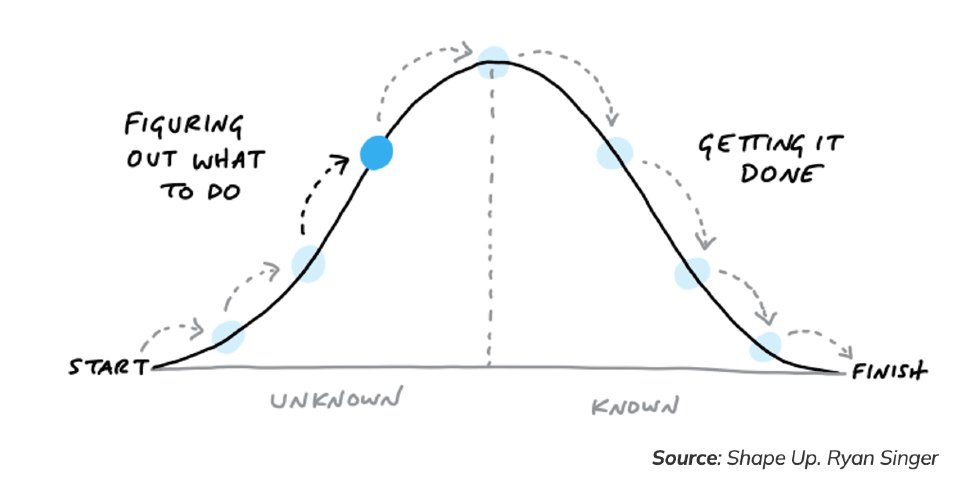
The unknown space of figuring out is where I usually find most problems. It's where teams hit the wall of ambiguity, where assumptions are made, and where task-level strategies are locked in. This is where team leaders can support the most to unblock teams.
Tracking tasks using a hill chart is not only useful to understand how the team is progressing through ambiguity, but also to know when support is needed to overcome the hill.
Try it out!
ps: for more details, read Shape Up.
💡 Concept that I learned
"Law of inverse prioritization: The most important things in life are the least likely to get done. Why does this happen? (1) false sense of progress from urgent tasks; (2) easier to being busy vs. discomfort; and (3) important things rarely feel urgent."
From Greg McKeow & Tim Ferriss podcast on Tactics and Strategies for a 2026 Reboot.
👨🏻💻 Interesting links
- AI design isn't about making everything conversational. This is a great playbook on building trust through visibility, explainability, and keeping humans in control for AI-enabled apps
- Huge swathes of human knowledge are missing from the internet. By definition, generative AI is shockingly ignorant too (Must read!)
- An ant is drowning: here’s how to decide if you should save it
🖋️ Quote of the week
“Principle of free thought. Not free thought for those who agree with us but freedom for the thought that we hate.” – Holmes (1929)